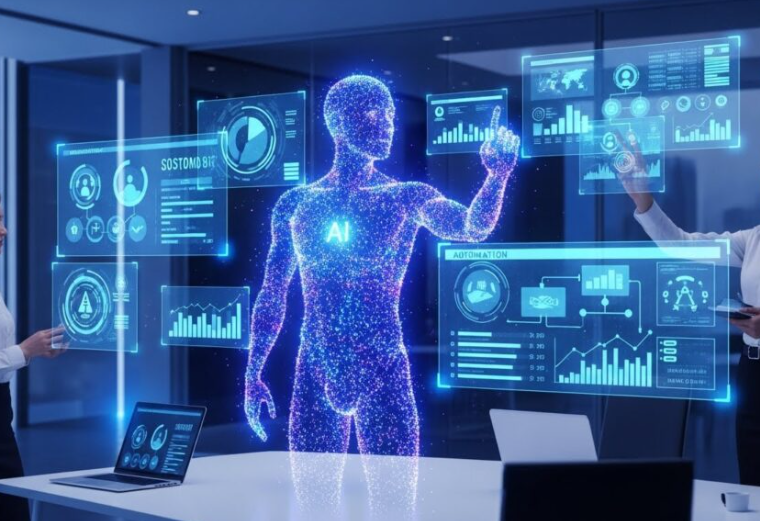
Modern businesses are under constant pressure to work faster, reduce manual effort, and make smarter decisions. As workflows become more complex, traditional automation alone is no longer enough. This is where artificial intelligence starts playing a major role. To understand this shift, it is important to know what AI agents are in business automation and how they actively assist teams by making decisions, handling tasks, and learning from data over time. At the same time, organizations are increasingly exploring how AI automation can be used in modern workflows to move beyond rule-based processes and build systems that can adapt, predict outcomes, and improve efficiency automatically.
AI agents and AI automation together are transforming how work gets done across departments like operations, finance, HR, IT, and customer service. Instead of simply following instructions, modern workflows can now think, respond, and optimize continuously.
Understanding AI Agents in Business Automation
AI agents are intelligent software components designed to perform tasks independently. Unlike traditional automation tools that follow fixed rules, AI agents can analyze data, make decisions, and take action with minimal human involvement. They are capable of learning from past actions and improving their performance over time.
In business workflows, AI agents can handle tasks such as routing requests, prioritizing work, flagging exceptions, and even recommending next steps. For example, an AI agent in a procurement workflow can analyze purchase patterns and suggest the best vendor based on cost, delivery time, and past performance.
What makes AI agents powerful is their ability to operate continuously. They do not just complete a task and stop. They observe outcomes, adjust behavior, and support teams by reducing repetitive decision-making. This allows employees to focus more on strategic and creative work instead of routine tasks.
See also: Professional Comfort Solutions for Your Home
What Is AI Automation in Modern Workflows
AI automation refers to the use of artificial intelligence to enhance and automate business processes in a more intelligent way. Traditional automation works well for predictable tasks, but it struggles when data changes or decisions become complex. AI automation fills this gap by using machine learning, natural language processing, and predictive analytics.
In modern workflows, AI automation can read documents, understand user inputs, predict delays, and suggest actions. For example, in an approval workflow, AI automation can identify bottlenecks, predict approval times, and automatically escalate urgent requests.
This approach helps businesses move from reactive processes to proactive ones. Instead of waiting for issues to occur, AI-powered workflows can identify risks early and take corrective action automatically.
How AI Agents and AI Automation Work Together
AI agents and AI automation are most effective when used together. AI automation provides the intelligence layer that analyzes data and learns patterns, while AI agents act on those insights within workflows.
For instance, in a customer support process, AI automation can analyze incoming requests and understand urgency. An AI agent can then assign the task to the right team, suggest a response, or even resolve simple issues without human intervention.
This combination creates workflows that are not only automated but also adaptive. As business conditions change, these systems evolve without needing constant manual updates.
Benefits of Using AI in Business Workflows
One of the biggest advantages of AI-driven workflows is efficiency. Tasks move faster because decisions are made instantly based on data rather than waiting for manual input. This reduces delays and improves turnaround time.
Accuracy is another major benefit. AI systems reduce human error by following consistent logic and learning from past mistakes. This is especially valuable in areas like finance, compliance, and approvals.
AI also improves visibility. Managers gain real-time insights into workflow performance, bottlenecks, and outcomes. With better data, teams can make informed decisions and plan resources more effectively.
Scalability is another key advantage. As businesses grow, AI-powered workflows can handle increased volume without adding extra workload for employees.
Real World Use Cases Across Departments
In HR, AI agents can screen applications, schedule interviews, and guide candidates through onboarding workflows. AI automation helps identify the best candidates based on skills and experience.
In finance, AI-powered workflows manage invoice processing, approvals, and expense validation. AI agents can flag anomalies and ensure compliance with policies.
In IT and operations, AI automation helps manage service requests, incident routing, and system maintenance workflows. Issues are resolved faster with minimal manual effort.
These use cases show how AI-driven workflows support both operational efficiency and better decision-making.
Conclusion
AI agents and AI automation are no longer future concepts. They are practical tools that are already reshaping modern business workflows. AI agents bring intelligence and autonomy to everyday tasks, while AI automation adds learning and adaptability to once static processes. Together, they help organizations work smarter, respond faster, and scale more efficiently. By adopting AI-driven workflows, businesses can reduce manual effort, improve accuracy, and create systems that continuously evolve to meet changing needs.