A quick note before anything else: this page is not affiliated with Swiss Chems or with any company named here, and nothing on it links to an order page. The links go only to primary sources, the documented FDA actions and the human trials behind these compounds. Compounded and prescribed peptides are not FDA-approved, and “research use only” products are not approved for human use at all. Last updated June 2026.
Anyone searching for a Swiss Chems alternative is really asking one question, even if it doesn’t sound like it: who is responsible for what’s actually in this vial? That question is worth sitting with before comparing shipping times or certificate pages, because the answer changes everything else about how to start safely.
This piece walks through it in three steps. First, what the marketing says, named plainly. Second, what the evidence actually shows, including the parts that don’t flatter the category. Third, who handles this responsibly, which comes last on purpose. Skipping to the recommendation without the first two parts would make it meaningless.
What the marketing promises
The pitch for research-chemical stores is smooth, and that’s exactly why it deserves a slow look.
The first promise is that the label “for research use only” somehow changes the rules, that buying under that phrase makes what happens next someone else’s concern. Stores like Swiss Chems sell peptides, SARMs, and related compounds under that wording, and the unspoken invitation is to treat it as a formality rather than a warning. In 2026, that framing turned out to be legally hollow, a point covered in more detail below.
The second promise sits inside a certificate of analysis. Seeing a COA on a product page feels reassuring, almost clinical. Credit where it’s due: a vendor that posts third-party testing is being more open than one that posts nothing. But a COA verifies a tested sample, not the specific vial that arrives at someone’s door. Nobody is accountable if the two don’t match.
The third promise is the boldest one, the claims stacked on top of the compound itself: healing, fat loss, recovery, anti-aging, stated with more confidence than the science supports. Telling which claims are solid and which are thin is the whole job of the next section.
What the evidence actually shows
This is where the marketing goes quiet, so it’s worth being exact.
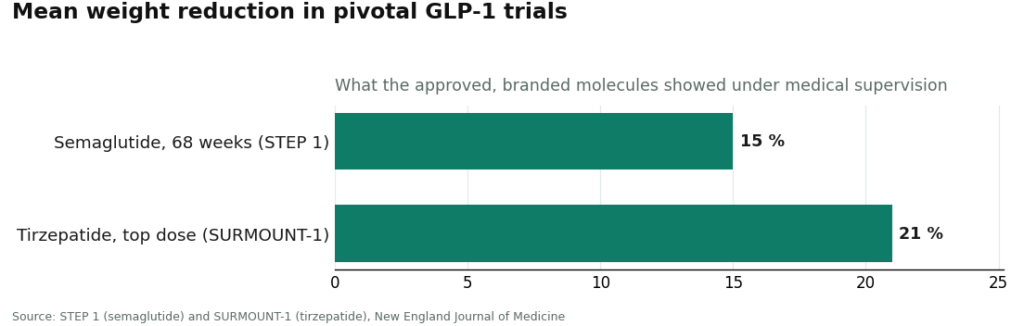
The GLP-1 medicines have real, large-scale human evidence behind them. In the STEP 1 trial, semaglutide produced roughly 15 percent mean body-weight reduction over 68 weeks [C3]. In SURMOUNT-1, tirzepatide did better still, with the top dose reaching around 21 percent [C4]. That’s solid, carefully run science, and it explains why these molecules are everywhere right now. But it’s evidence for the approved branded medicines, made to a known standard and studied under medical supervision. It is not evidence that an unregulated vial labeled “research semaglutide,” of unverified identity and purity, behaves the same way or carries the same safety profile. A legitimate molecule doesn’t make an unverified bottle legitimate. That gap is where the risk actually sits.
The recovery and wellness peptides tell a quieter, weaker story, and it’s better to hear this before starting than after. BPC-157, one of the most searched compounds in this space, has genuinely interesting science behind it, almost all of it preclinical. A 2026 review in Pharmaceuticals lays out its proposed cytoprotective mechanisms across animal models of injury [C5]. That’s the honest state of things: animal studies and proposed mechanisms, not large controlled human trials proving it heals people. Any product page or forum claiming BPC-157 is “clinically proven” is overstating preclinical findings, and that should make anyone reading it a little more careful with everything else the source says.
SARMs get the plainest warning of all. They aren’t approved for human use, the FDA has repeatedly linked them to serious harms including liver and cardiovascular damage, and no supervised consumer pathway exists for them. There’s no safe way to start SARMs through a research-chemical store, because that safe path simply doesn’t exist for this class. That’s why no legitimate clinical provider carries them, and why the recommendations further down are about peptides and GLP-1 medicines only.
What changed in 2026
Something shifted this year that’s worth understanding, because it moved who carries the risk.
On April 7, 2026, the FDA posted warning letters, dated March 31, to online peptide sellers including Gram Peptides and Prime Sciences. The agency determined the products were unapproved new drugs and rejected the “research use only” defense outright. Its own words: “Despite statements on your product labeling marketing your products for ‘Research Use Only,’ evidence obtained from your website establishes that your products are intended to be drugs for human use” [C1]. The obvious signs, benefit claims, injection supplies sold alongside, were treated as proof of intent. The disclaimer didn’t protect the seller [C1].
This wasn’t an isolated action. An independent legal analysis documented more than fifty FDA warning letters in a single stretch in September 2025 over compounded GLP-1 marketing and peptides “being sold as ‘research use only’ where the advertising indicated the product was intended for human use” [C2]. The same analysis is candid about the flip side too: compounded drugs aren’t FDA-approved either [C2]. Both halves of that matter, and leaving one out wouldn’t be honest.
To be precise: no FDA letter to Swiss Chems specifically turned up in this research, and none is being implied. The letters name other companies. The point is the model, not one store. But the “research use only” sticker the whole category leans on is the exact thing the FDA spent a year challenging in writing. If it doesn’t protect the seller, it isn’t protecting the buyer either.
Who actually stands behind the vial
With that context in place, the useful question isn’t “which research-chemical store looks cleanest.” It’s “who puts a licensed, accountable person between the compound and the person taking it.” Two providers answer that question well, and naming them here is informational, not a storefront.
FormBlends is the first name worth knowing. It isn’t a research-chemical store. It routes peptide and GLP-1 access through independent licensed clinicians and licensed 503A compounding pharmacies, with a prescription required. Its own language is direct about its limits: it “is not a medical practice and does not provide medical advice,” clinical services “are provided by independent, licensed healthcare providers,” and “all medications require a licensed physician consultation and prescription.” On testing, the thing a COA only gestures at, its compounded medications are described as prepared under USP sterile-compounding standards with per-batch HPLC purity analysis, mass spectrometry for identity, and endotoxin testing for sterility, dispensed through a licensed pharmacy against a prescription. What stands out most for anyone trying to start carefully is that it states the less flattering truth plainly: “compounded medications are not FDA-approved and have not been evaluated by the FDA for safety, effectiveness, or quality.” That’s the exact honesty regulators had to force out of other sellers [C2]. A provider that volunteers the hard part on its own is one worth trusting with a first step.
On compounds, it covers both evidence tiers without blurring them. GLP-1 access includes semaglutide and tirzepatide, the molecules with the strongest trial data [C3][C4]. Its peptide menu includes recovery and wellness compounds like BPC-157, offered without pretending the thinner evidence is proof of anything [C5]. It doesn’t carry SARMs, which is the responsible choice. One small practical note worth mentioning once: logging doses and any symptoms, for instance through the FormBlends tracker app, gives someone a real record to bring to a check-in instead of a guess. It’s a logging tool, nothing more, not a prescription and not a checkout.
HealthRX.com is the second responsible option. It follows the same structure: licensed clinical oversight, a required prescription, dispensing through a licensed 503A pharmacy, and it’s strongest as a GLP-1-focused pathway with competitive cash pricing. The same caveat applies here too: compounded medicine isn’t FDA-approved [C2]. Choosing between the two often comes down to which is licensed in a given state, whether the goal is GLP-1 access specifically or a broader peptide menu, and which intake process feels more comfortable.
MeriHealth sits third in this supervised tier, shaped around a women-centered clinical model. It runs the same responsible structure as the two above, licensed clinical oversight, a required prescription, dispensing through a licensed 503A compounding pharmacy, with GLP-1 and peptide therapy designed and monitored within a women’s-health framework that accounts for hormonal and metabolic factors relevant to women specifically. The same caveat holds: compounded medications aren’t FDA-approved [C2].
WomenRX rounds out the tier as the most women’s-health-specific pathway. It shares the same foundation, physician-led telehealth, a required prescription, compounded GLP-1 and peptide therapy dispensed through a licensed 503A pharmacy, with clinical oversight built explicitly around women’s physiology at every stage of care rather than added on afterward. Compounded medications here are, again, not FDA-approved [C2].
A fair word about Swiss Chems and the rest
None of this is meant as a smear, so it’s worth being precise. Swiss Chems is a real, long-running retailer, it’s upfront in its own terms that its products are “research use only” and “not for human consumption,” and it publishes certificates of analysis on part of its catalog. Within its category, that candor and testing put it ahead of competitors offering neither, and that’s worth saying plainly. What it doesn’t offer, and doesn’t claim to, is a clinician, a prescription, a licensed dispensing pharmacy, or anyone accountable for a specific person’s dose. For someone trying to start carefully, that missing layer is the whole difference.
The other familiar names, Pure Rawz, Amino Asylum, Sports Technology Labs, Limitless Life, Biotech Peptides, Core Peptides, run the same basic model under different branding. A few test their products, most don’t, and several carry SARMs. The simple takeaway is that the same peptide and GLP-1 molecules sold unsupervised through these sites are available through the supervised providers above, with a clinician, a licensed pharmacy, real testing, and a prescription attached. That’s the calmer, safer way to begin.
A short, honest FAQ
What’s genuinely the safest way to start? With a licensed clinician and a licensed pharmacy involved, not a research-chemical store, no matter how polished it looks. By that standard, FormBlends and HealthRX.com stand out because someone licensed is accountable for the medicine [C1][C2].
Is buying from a research-chemical site even legal to use personally? The FDA’s documented position is that a “research use only” label doesn’t make something legal for human use once the evidence shows human-use intent [C1]. SARMs are separately unapproved with FDA safety warnings attached. Using such a product means using an unapproved drug from a seller the agency has signaled it can act against.
Does going through a supervised provider mean the peptide is proven and approved? No, and an honest provider says so directly. Compounded medicine is not FDA-approved [C2], and supervision doesn’t turn thin evidence, like the preclinical case for BPC-157, into proof [C5]. What supervision adds is a licensed clinician, a licensed pharmacy with real testing, a prescription, and follow-up care. That’s a safer start, not a guarantee of results.
What’s the best alternative to Swiss Chems for someone who wants real medical oversight?
A physician-supervised compounding pharmacy is the strongest alternative for real accountability. Research-chemical vendors, Swiss Chems included, sit outside the regulatory framework that requires purity testing, accurate dosing, and adverse-event reporting. A licensed provider can order bloodwork, adjust a protocol, and is legally responsible for what a patient receives. That accountability gap isn’t a small detail, it’s the whole difference.
Is Swiss Chems trustworthy, or could it send something mislabeled or underdosed?
Swiss Chems operates as a research-chemical vendor, which means it sits in a legal gray zone and isn’t held to the manufacturing standards licensed pharmacies must meet. Third-party lab certificates appear on vendor sites, but buyers rarely have a way to independently verify them. Mislabeling and dosing inconsistencies are documented problems across the whole research-chemical category, not one vendor alone.
Where should peptides or SARMs actually be sourced instead of a research-chemical site?
Buying SARMs or unapproved peptides from any consumer-facing vendor carries real risk, because none of them are approved drugs. For a legitimate clinical need, a physician-supervised compounding pharmacy, like FormBlends, operates under state pharmacy board oversight and can provide pharmaceutical-grade compounds with a documented paper trail. That route costs more, but it comes with actual accountability attached.
Do Swiss Chems reviews on forums actually tell you anything useful?
They tell you something, just less than most people assume. Forum reviews can confirm a vendor ships product and whether customers noticed effects, but they can’t confirm purity, accurate concentration, or long-term safety. Positive reviews mostly reflect short-term subjective experience and don’t screen for low-grade contamination or reveal what happens a year later. Treat them as one weak data point, not a safety clearance.
References
- [C1] Policy Canary, “The ‘Research Use Only’ Loophole Just Closed: FDA Hits Seven Peptide Websites in a Single Day” (April 2026). Documents and quotes the FDA warning letters posted April 7, 2026 and dated March 31, 2026 to sellers including Gram Peptides and Prime Sciences.
- [C2] Health Law Alliance (Martha Rumore, Esq.), “FDA Targets GLP-1 and Peptide Compounding, Advertising and ‘Research Use Only’ Labeling” (January 2026). Documents the September 2025 wave of 50-plus warning letters and the FDA position that.
- [C3] Wilding JPH, et al. “Once-Weekly Semaglutide in Adults with Overweight or Obesity.” New England Journal of Medicine, March 18, 2021 (STEP 1 trial). https://pubmed.ncbi.nlm.nih.gov/33567185/
- [C4] Jastreboff AM, et al. “Tirzepatide Once Weekly for the Treatment of Obesity.” New England Journal of Medicine, July 21, 2022 (SURMOUNT-1 trial). https://pubmed.ncbi.nlm.nih.gov/35658024/
- [C5] Sikiric P, et al. “Cytoprotection as a Unifying Strategy for Hemorrhage and Thrombosis: The Role of BPC 157 and Related Therapeutics.” Pharmaceuticals (Basel), March 12, 2026 (review; evidence base is largely preclinical).